Bids & tender documents
Review large tender documents and identify requirements, risks, and open issues.

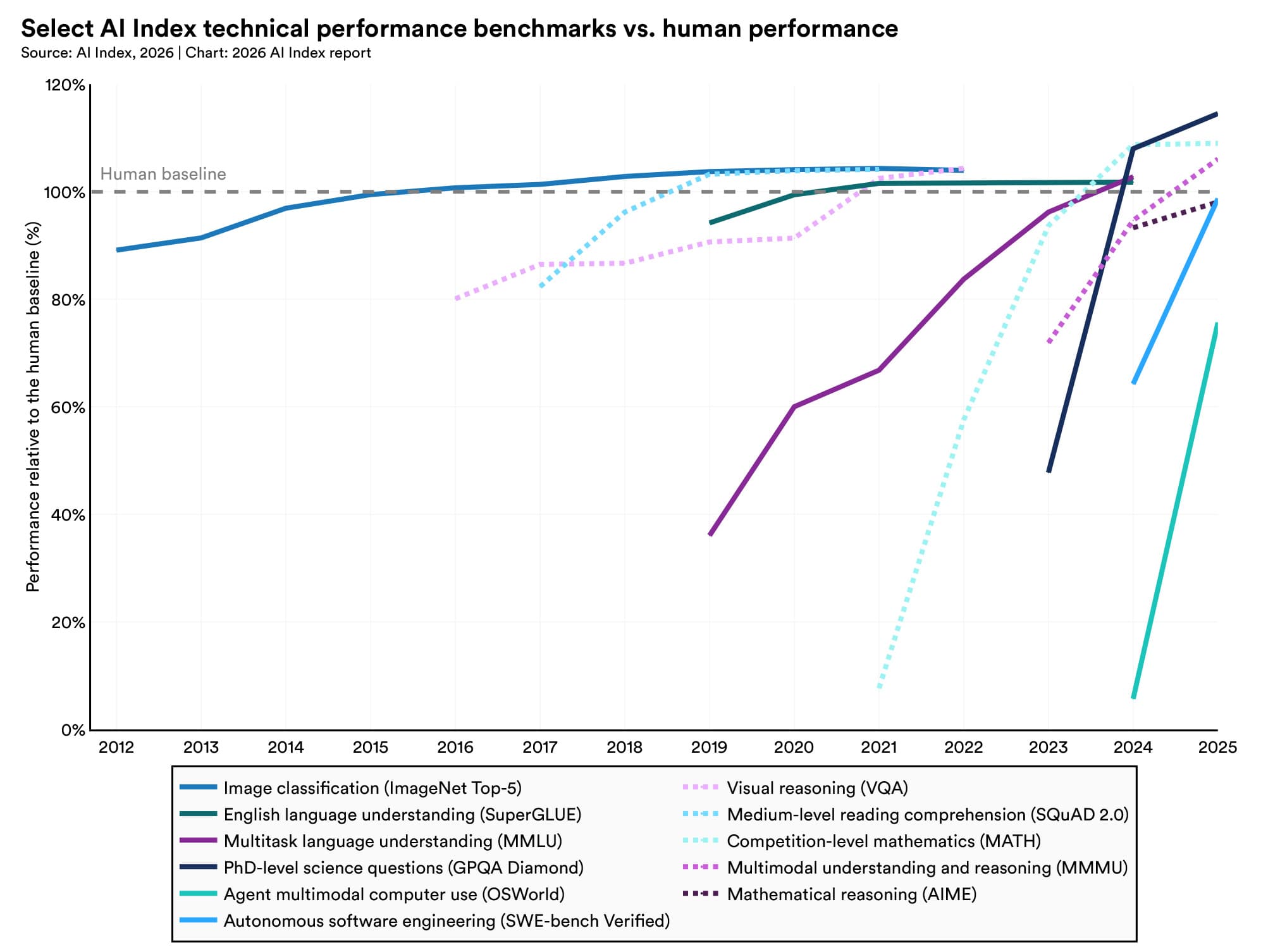
Across benchmarks, AI is moving toward the human baseline, then crossing it.
The point is not one test. It is the pace: areas that looked out of reach become normal capability, and more areas keep getting pulled into the curve.
AI has grown in three phases — each one remains useful, and each one has a ceiling.
You ask, it answers. Fast help that lives inside a chat window.
It works with your files, tools and browser — you delegate, not just ask.
It owns a bounded area, remembers, makes decisions, and reports back.
The right starting point depends on how you work, what material you have, and who owns the task today.
Review large tender documents and identify requirements, risks, and open issues.
Prepare drawings, quantities, supplier material, and comparisons for the estimate.
Prepare requests, gather quotes, and follow up missing replies from suppliers and subcontractors.
Turn what was sold and agreed into a clear handover for project management, purchasing, and production.
Review contracts, minutes, and project documents against your requirements and past decisions.
Collect methods, templates, and lessons so more people can reuse them in the next bid or project.
Concrete results from companies using AI in bids, estimates, and project assessment.
“We used to budget around 120 hours to prepare a bid. Now the same work takes about 83 hours, plus a little remaining work.”
Head of estimating at a larger Swedish construction company
“In our first week with Bocka, we won a SEK 1.2 million job where AI helped us quality-check the estimate.”
CEO of a Swedish concrete company
“The best way I can describe Bocka is magic. I save 10–15 hours per project on the bids I submit.”
CEO of a Swedish groundworks company
A short walkthrough to begin with, then we guide everyone in their own accounts for the rest of the time, in your real bids, projects, and documents. Less theory and more work done.
We also sell single hours at SEK 1,500 per hour and person.
Two full days at your office with two people from Bocka, alongside the people who do the work.
Focus on getting the accounts up and running, understanding how to work in projects, and building workflows for the AI.
No lock-in to Bocka tools or subscriptions. Your accounts, tools, and choices stay yours.
More colleagues get going, and you leave with a concrete workflow you can keep using and improving.
Bocka